

Protein Therapeutics Market Set to Reach USD 740.07 Bn by 2034, Growing at 7.08% CAGR
The global protein therapeutics market size was valued at USD 401.89 billion in 2025 and is predicted to hit around USD 740.07 billion by 2034, rising at a 7.08% CAGR, a study published by Towards Healthcare a sister firm of Precedence Research.
Ottawa, Jan. 13, 2026 (GLOBE NEWSWIRE) -- The global protein therapeutics market size is calculated at USD 430.36 billion in 2026 and is expected to reach around USD 740.07 billion by 2034, growing at a CAGR of 7.08% for the forecasted period.
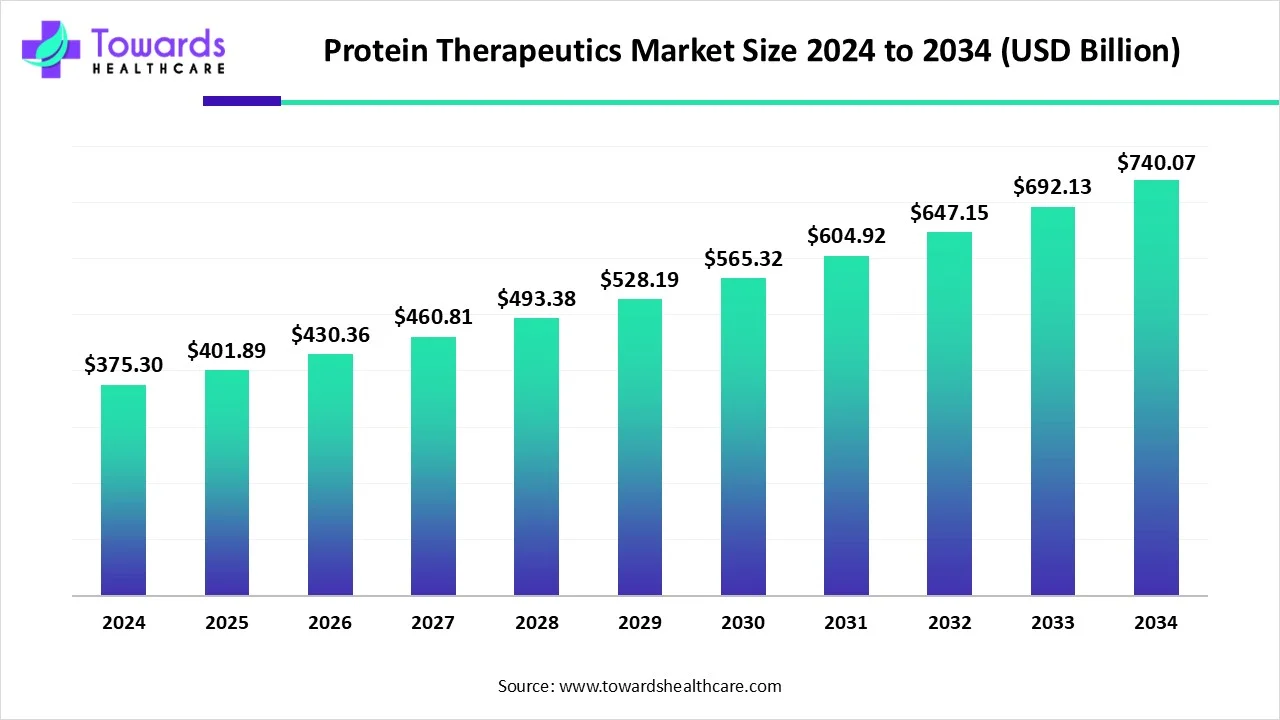
The Complete Study is Now Available for Immediate Access | Download the Sample Pages of this Report @ https://www.towardshealthcare.com/download-sample/5577
Key Takeaways
- North America accounted for the largest share of the market in 2024.
- Asia Pacific is expected to grow at the fastest CAGR in the studied years.
- By product type, the monoclonal antibodies segment registered dominance in the protein therapeutics market in 2024.
- By product type, the insulin segment is expected to grow at a lucrative CAGR during 2025-2034.
- By application type, the metabolic disorders segment led the market in 2024.
- By application type, the immunological disorders segment is expected to grow notably in the upcoming years.
What are the Extensive Developments in Protein Therapeutics?
The protein therapeutics market mainly covers huge, biologically derived medicines, often designed by recombinant DNA technology, and utilized to treat, prevent, or cure diseases. Moreover, the global market is propelled by a growing demand for targeted treatments, R&D in gene/enzyme therapies, and increased access via biosimilars. Furthermore, researchers and leading firms are promoting developments in newer drug modalities, including antibody-drug conjugates (ADCs) and cell therapies, also optimizing drug delivery systems, and integrating artificial intelligence (AI) in discovery and engineering.
What are the Prominent Drivers in the Protein Therapeutics Market?
Day by day, the globe is increasingly demanding tailored interventions, specifically in oncology, as protein therapeutics offer specificity for disease targets. As well as, the market is fueled by ongoing technological groundbreakings in biotechnology, such as recombinant DNA technology, monoclonal antibodies, antibody-drug conjugates (ADCs), fusion proteins, and biosimilars. Alongside, several giant pharma companies are actively investing in R&D to bolster drug development approaches.
What are the Substantial Trends in the Protein Therapeutics Market?
- In November 2025, Accipiter Biosciences closed $12.7 million in seed funding to advance a novel class of de novo multifunctional protein therapeutics evolved to treat complex diseases.
- In November 2025, AI Proteins secured $41.5M Series A Funding to drive new miniprotein therapeutics.
- In October 2025, Pinetree Therapeutics raised $47 million in an oversubscribed Series B to strengthen next-generation protein degraders in oncology.
What is the Emerging Challenge in the Protein Therapeutics Market?
Firms are facing limitations, such as unaffordable R&D, complex manufacturing, like cell lines, bioreactors, and stricter quality control. Also, some companies may have a barrier in protein physicochemical stability, absorption, distribution, and efficient delivery, especially transdermal.
You can place an order or ask any questions, please feel free to contact us at sales@towardshealthcare.com
Regional Analysis
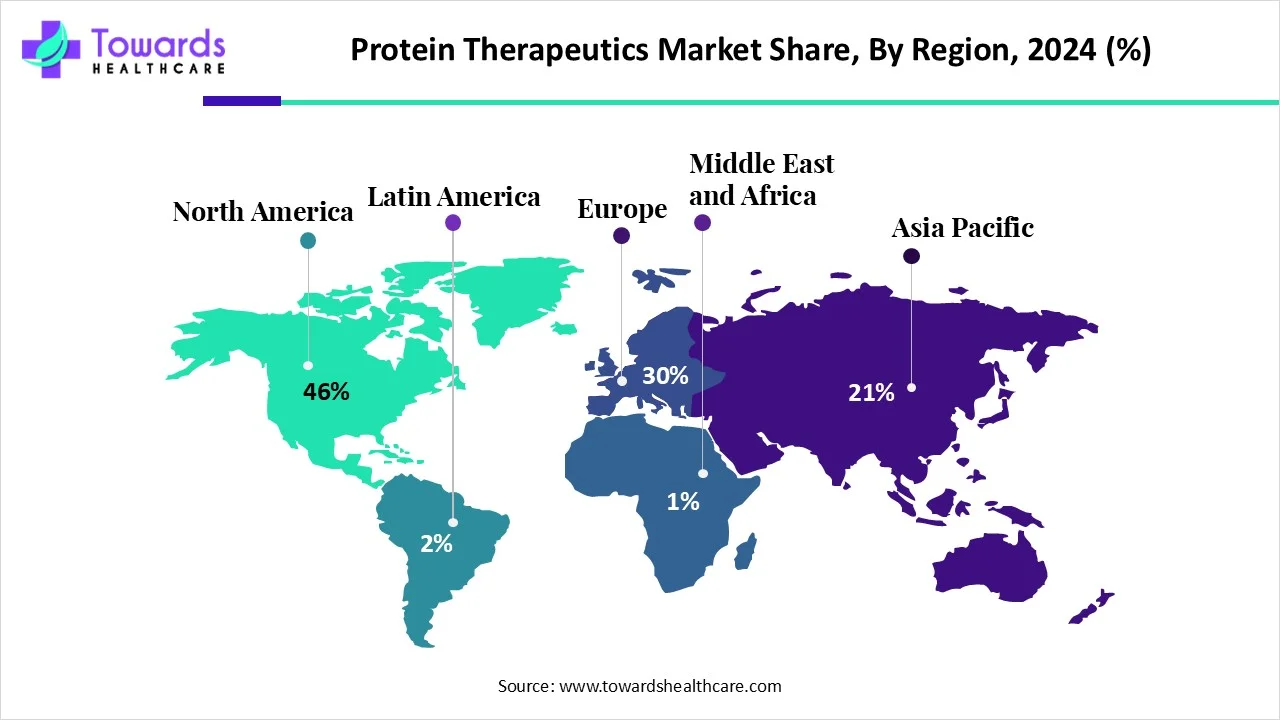
What Made North America Dominant in the Market in 2024?
By capturing a major share, North America led the protein therapeutics market by 46% in 2024. A significant driver is a huge rise in cancer, diabetes, autoimmune, and metabolic disorders, which directly accelerate demand for protein-based treatments, such as insulin, GLP-1 agonists, and immune checkpoint inhibitors. Additionally, the region has advanced systems, greater healthcare expenditure, and robust reimbursement policies that provide access and adoption of expensive biologics. Recently, the FDA approved numerous new protein therapeutics, particularly monoclonal antibodies (mAbs) and gene therapies.
The U.S. protein therapeutics market is expanding rapidly, propelled by robust clinical pipelines, research infrastructure, and supportive regulatory pathways that speed biologic approvals. Demand rises as chronic diseases like cancer and autoimmune disorders increase. Investment in novel biologics, precision medicine platforms, and AI-assisted drug development further accelerates innovation and growth.
For instance,
- In October 2025, Nabla Bio entered into a new, multi-year research collaboration with Takeda to promote AI-assisted design of protein therapeutics.
How did the Asia Pacific Expand Notably in the Protein Therapeutics Market in 2024?
Asia Pacific is anticipated to witness rapid expansion during the prospective period, due to the presence of favourable government policies, robust R&D investment in biotech, progression of cost-effective biosimilars, and the stepping towards tailored medicine. Incorporation of novelty in the market comprises Efsubaglutide Alfa, a new fusion protein that received approval from China’s NMPA for type 2 diabetes. However, India and South Korea are widening their production facilities of a variety of protein therapies.
For instance,
- In October 2025, Forlong Biotechnology received a prominent payment under its licensing and alliance agreements with Shell BioTech and a third party for a protein therapy employing its proprietary Fbody technology.
China’s protein therapeutics landscape is experiencing strong expansion, driven by rising healthcare investment, regulatory reforms, domestic biotech innovation. Local companies are broadening biologic pipelines and increasing approvals of new therapies. Collaboration with global partners, improvements in production capacity support wider access while addressing unmet medical needs across diverse therapeutic areas.
Get the latest insights on life science industry segmentation with our Annual Membership: https://www.towardshealthcare.com/get-an-annual-membership
Segmental Insights
By product type analysis
Which Product Type Led the Protein Therapeutics Market in 2024?
In 2024, the monoclonal antibodies segment held the dominating share of the market. The segmental growth is mainly driven by advanced biotechnology, including genetic engineering, humanized mAbs, and their enhanced specificity/effectiveness. Alongside, researchers are progressing innovation in bispecific antibodies (BsAbs) and antibody-drug conjugates, which highly leverage mAbs. Recent developments include Kisunla (donanemab), a humanized anti-amyloid-beta mAb for the treatment of early symptomatic Alzheimer's disease, & Bizengri (zenocutuzumab), a bispecific antibody (HER2 x HER3) for advanced non-small cell lung cancer and pancreatic adenocarcinoma, etc.
Besides this, the insulin segment is predicted to witness significant growth. A massive rise in the number of Type 1, Type 2, and gestational diabetes cases is widely demanding insulin and its derivatives. In 2024, the FDA approved Insulin icodec, created for once-weekly dosing, which gains a stable, consistent state after several weeks. It is mainly approved in Europe, Canada, and other regions. The adoption of nanotechnology encourages encapsulation of insulin in protective coatings, like gelatin, chitosan, and alginate-based nanoparticles, to remain stable in the digestive tract and be absorbed in the intestine or liver.
By application type analysis
Why did the Metabolic Disorders Segment Dominate the Market in 2024?
The metabolic disorders segment registered dominance in the protein therapeutics market in 2024. The worldwide cases of diabetes and obesity are increasingly demanding insulin and GLP-1 agonists. The revolutionary era is promoting the use of the luminal unfolding microneedle injector (LUMI) to inject protein drugs directly into the gastrointestinal wall, & combination of cagrilintide and semaglutide, which has superior metabolic benefits, like increased weight loss and optimized glycemic control.
In the future, the immunological disorders segment is estimated to register significant expansion. Many regions are facing a rise in instances of rheumatoid arthritis, psoriasis, multiple sclerosis, and inflammatory bowel disease, which demand biologics. Ongoing clinical studies are assessing anti-CD19 CAR-T cell therapies for Systemic Lupus Erythematosus (SLE), systemic sclerosis, and myasthenia gravis. Meanwhile, Povetacicept, a Fc fusion protein in Phase 2 trials, which inhibits BAFF and APRIL in autoimmune cytopenias, like ITP.
Become a valued research partner with us - https://www.towardshealthcare.com/schedule-meeting
What are the Major Developments in the Protein Therapeutics Market?
- In December 2025, Cipla Limited launched Afrezza, an insulin inhalation powder in India.
- In November 2025, NEOK Bio emerged from Stealth with $75 million in Series A funding to bolster next-generation bispecific antibody drug conjugates (ADC) in oncology.
- In September 2025, Dualitas Therapeutics introduced a $65 million series A financing round and a pipeline of bispecific antibodies for immune and inflammatory diseases.
Protein Therapeutics Market Key Players List
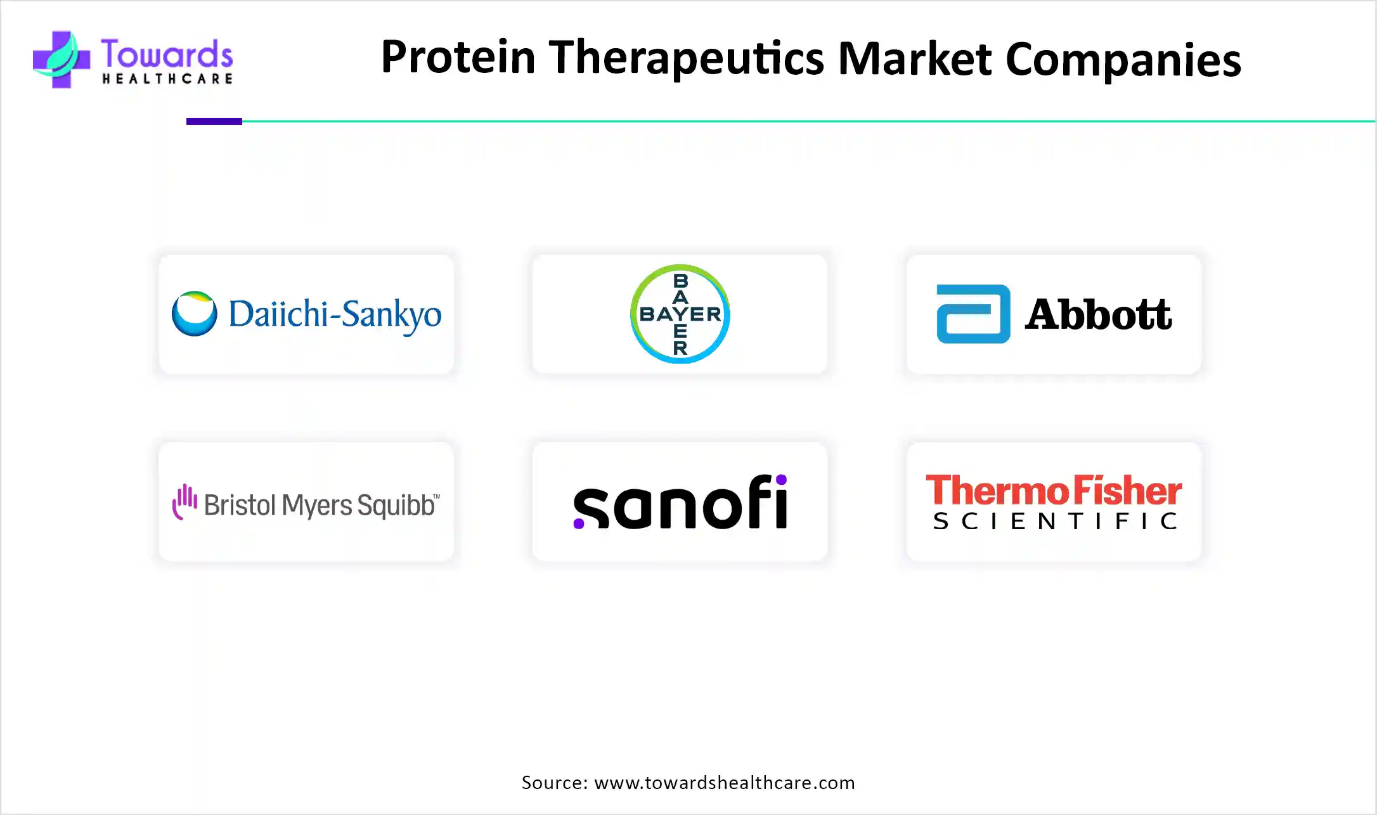
- Daiichi Sankyo Company
- Bayer AG
- Abbott
- Bristol-Myers Squibb
- Genzyme Corporation (Sanofi)
- Sanofi
- AbbVie, Inc.
- Thermo Fisher Scientific, Inc.
- Amicus Therapeutics
- Leadiant Biosciences
Browse More Insights of Towards Healthcare:
The protein chip market size marked US$ 2.36 billion in 2025 and is forecast to experience consistent growth, reaching US$ 2.54 billion in 2026 and US$ 4.98 billion by 2035 at a CAGR of 7.78%.
The global protein labeling market size is anticipated to grow from USD 2.89 billion in 2025 to USD 6.02 billion by 2034, with a compound annual growth rate (CAGR) of 8.48% during the forecast period from 2025 to 2034.
The global protein engineering market size is calculated at US$ 3.08 in 2024, grew to US$ 3.58 billion in 2025, and is projected to reach around US$ 13.84 billion by 2034. The market is expanding at a CAGR of 16.27% between 2025 and 2034.
The global protein expression technology market size is calculated at USD 2.85 in 2024, grew to USD 3.05 billion in 2025, and is projected to reach around USD 5.58 billion by 2034. The market is expanding at a CAGR of 6.94% between 2025 and 2034.
The global proteinase K market size is calculated at USD 5.23 billion in 2025, grew to USD 5.68 billion in 2026, and is projected to reach around USD 11.87 billion by 2035. The market is expanding at a CAGR of 8.54% between 2026 and 2035.
The global C-reactive protein testing market size is calculated at USD 5.58 billion in 2024, grew to USD 5.6 billion in 2025, and is projected to reach around USD 5.75 billion by 2034. The market is expanding at a CAGR of 0.3% between 2024 and 2034.
The plasma protein products market was estimated at US$ 32.8 billion in 2023 and is projected to grow to US$ 72.9 billion by 2034, rising at a compound annual growth rate (CAGR) of 7.53% from 2024 to 2034.
The global G-protein coupled receptors market size is calculated at US$ 3.86 in 2024, grew to US$ 4.06 billion in 2025, and is projected to reach around US$ 6.37 billion by 2034. The market is expanding at a CAGR of 5.14% between 2024 and 2034.
The recombinant lysyl endopeptidase market was estimated at US$ 38 million in 2023 and is projected to grow to US$ 67.06 million by 2034, rising at a compound annual growth rate (CAGR) of 5.3% from 2024 to 2034.
The recombinant human hair keratin protein market is experiencing significant expansion, with projections indicating a revenue increase reaching several hundred million dollars by the end of the forecast period, spanning 2024 to 2034.
Segments Covered in the Report
By Product
- Monoclonal Antibodies
- Insulin
- Fusion Protein
- Erythropoietin
- Interferon
- Human Growth Hormone
- Follicle Stimulating Hormone
By Applications
- Metabolic Disorders
- Immunologic Disorders
- Hematological Disorders
- Cancer
- Hormonal Disorders
- Genetic Disorders
By Region
- North America
- U.S.
- Canada
- Asia Pacific
- China
- Japan
- India
- South Korea
- Thailand
- Europe
- Germany
- UK
- France
- Italy
- Spain
- Sweden
- Denmark
- Norway
- Latin America
- Brazil Mexico
- Argentina
- Middle East and Africa (MEA)
- South Africa
- UAE
- Saudi Arabia
- Kuwait
Immediate Delivery Available | Buy This Premium Research @ https://www.towardshealthcare.com/checkout/5577
Access our exclusive, data-rich dashboard dedicated to the healthcare market - built specifically for decision-makers, strategists, and industry leaders. The dashboard features comprehensive statistical data, segment-wise market breakdowns, regional performance shares, detailed company profiles, annual updates, and much more. From market sizing to competitive intelligence, this powerful tool is one-stop solution to your gateway.
Access the Dashboard: https://www.towardshealthcare.com/access-dashboard
About Us
Towards Healthcare is a leading global provider of technological solutions, clinical research services, and advanced analytics, with a strong emphasis on life science research. Dedicated to advancing innovation in the life sciences sector, we build strategic partnerships that generate actionable insights and transformative breakthroughs. As a global strategy consulting firm, we empower life science leaders to gain a competitive edge, drive research excellence, and accelerate sustainable growth.
You can place an order or ask any questions, please feel free to contact us at sales@towardshealthcare.com
Europe Region: +44 778 256 0738
North America Region: +1 8044 4193 44
APAC Region: +91 9356 9282 04
Web: https://www.towardshealthcare.com
Our Trusted Data Partners
Precedence Research | Towards Packaging | Towards Food and Beverages | Towards Chemical and Materials | Towards Dental | Towards EV Solutions | Healthcare Webwire
Find us on social platforms: LinkedIn | Twitter | Instagram | Medium | Pinterest


Legal Disclaimer:
EIN Presswire provides this news content "as is" without warranty of any kind. We do not accept any responsibility or liability for the accuracy, content, images, videos, licenses, completeness, legality, or reliability of the information contained in this article. If you have any complaints or copyright issues related to this article, kindly contact the author above.
