

Mental Health–Sleep Overlap Market is Expected to Reach USD 14.9 Billion by 2036, Driven by Integrated Care Models | FMI
Mental Health-Sleep Overlap Market
USA mental health services show 12% CAGR as work stress, economic pressure, and youth anxiety rise, while reduced stigma drives earlier care nationwide.
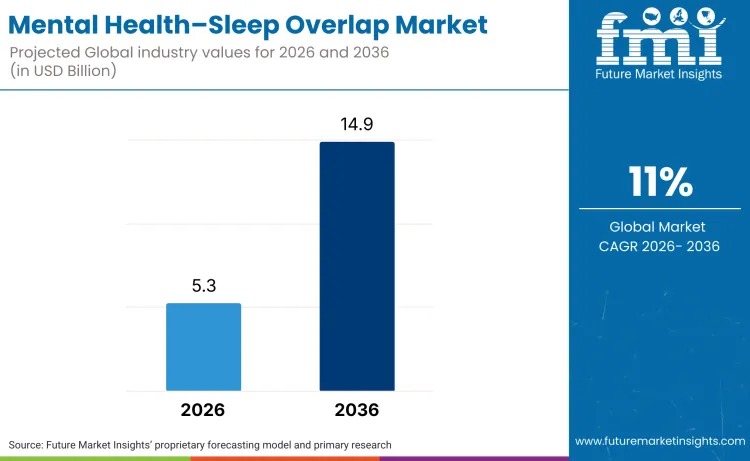
NEWARK, DE, UNITED STATES, February 6, 2026 /EINPresswire.com/ -- The global mental health–sleep overlap market is forecasting robust and sustained expansion over the next decade. According to FMI’s latest analysis, the market is expected to grow from USD 5.3 billion in 2026 to USD 14.9 billion by 2036, registering a compound annual growth rate (CAGR) of 11.0%.
The growth reflects a structural shift in healthcare delivery away from sequential treatment models toward simultaneous, integrated interventions that recognize sleep disturbances as both symptoms and modifiable risk factors for psychiatric disorders. The findings are based on FMI’s proprietary forecasting model, which integrates historical prevalence data, treatment utilization rates, digital health adoption trends, and evolving reimbursement and regulatory frameworks.
Discover Growth Opportunities in the Market – Get Your Sample Report Now
https://www.futuremarketinsights.com/reports/sample/rep-gb-31865
Market Context: Why Mental Health and Sleep Are Converging
Mental health disorders and sleep disturbances frequently co-occur, reinforcing one another and complicating treatment outcomes. FMI analysts note that clinical practice is increasingly aligning with evidence showing that integrated treatment approaches outperform psychiatric care alone.
Key clinical evidence shaping demand includes:
• JAMA Psychiatry findings indicating 68% remission rates for combined CBT-I and CBT, compared with 51% for psychiatric treatment alone.
• The Lancet Psychiatry research demonstrating that early treatment of insomnia in at-risk populations can reduce subsequent psychiatric disorder incidence by 58%.
This growing evidence base is accelerating adoption of care pathways that address bidirectional causality rather than isolated symptoms.
Digital Health Infrastructure Reshaping Access and Scale
FMI identifies the expansion of digital health infrastructure as a defining transformation of the market. Telehealth platforms and digital therapeutics now enable scalable delivery of integrated mental health–sleep interventions across geographic boundaries.
• 42% of mental health telehealth visits in the United States now include concurrent sleep health counseling, according to provider reports.
• FDA-authorized digital therapeutics such as Sleepio for insomnia and Daylight for anxiety are creating reimbursable, evidence-based options.
• Wearable-enabled sleep monitoring and AI-driven treatment optimization are improving personalization and continuity of care.
These developments are particularly impactful in Asia-Pacific markets, where shortages of specialist providers are driving demand for technology-enabled solutions.
Market Size and Growth Outlook (2026–2036)
Key Takeaways
• Industry Size (2026): USD 5.3 Billion
• Industry Value (2036): USD 14.9 Billion
• CAGR (2026–2036): 11.0%
FMI’s research approach combines historical prevalence of comorbid psychiatric-sleep disorders with adoption curves for telehealth, pharmacotherapy prescription patterns, and reimbursement sensitivity analyses through 2036.
Treatment and Clinical Pathway Insights
Leading Treatment Modalities
Psychiatric pharmacotherapy with favorable sleep profiles accounts for an estimated 28% of market revenue, supported by widespread clinical adoption. Commonly prescribed agents include sedating antidepressants, atypical antipsychotics with hypnotic properties, and orexin receptor antagonists such as lemborexant.
However, FMI notes a gradual shift toward multimodal treatment strategies, combining pharmacotherapy with behavioral interventions due to concerns over side effects and dependency risks.
Dominant Clinical Pathway
• Depression with insomnia management represents 34% of market activity, reflecting the well-established bidirectional relationship between these conditions.
• Integrated programs combining antidepressants with CBT-I are increasingly standard in outpatient and telehealth settings.
Regional Dynamics: Six Core Growth Markets
FMI identifies six countries as primary demand drivers through 2036:
• China: CAGR ~15.0%
• India: CAGR ~13.5%
• United States: CAGR ~12.0%
• Germany: CAGR ~10.5%
• France: CAGR ~7.5%
• United Kingdom: CAGR ~6.0%
Growth drivers vary by region but consistently include rising stress-related disorders, expanding telemedicine infrastructure, improved insurance coverage, and public policy support for integrated mental health care.
Policy, Guidelines, and Preventive Models Driving Adoption
Clinical guidelines are accelerating integration. The American Psychiatric Association’s 2023 Practice Guideline for major depressive disorder now includes CBT-I as a Grade A recommendation for depression with comorbid insomnia. This shift is influencing reimbursement decisions, clinician training, and care pathway design.
Preventive intervention models are also emerging as a new growth segment. Population-level screening and early intervention programs in educational institutions, workplaces, and employer-sponsored health plans are expanding the addressable market beyond treatment of established conditions.
Competitive Landscape and Recent Developments
Competition in the mental health–sleep overlap market is increasingly defined by clinical evidence generation, regulatory approvals, and integrated platform development, rather than traditional promotional strategies.
Notable developments include:
• October 2026: Lyra Health launched its first clinical-grade AI experience for mental health care.
• January 2025: Johnson & Johnson announced the acquisition of Intra-Cellular Therapies, Inc.
• January 2025: AbbVie acquired Nimble Therapeutics to expand its pipeline.
Key Companies Profiled
• Otsuka Pharmaceutical Co., Ltd.
• Johnson & Johnson
• Pfizer Inc.
• Teladoc Health, Inc.
• Big Health (Sleepio)
• Eli Lilly and Company
• AbbVie Inc.
• Teva Pharmaceutical Industries
• Lyra Health
• Spring Health
Outlook Through 2036
FMI concludes that the mental health–sleep overlap market is evolving into an evidence-based, digitally enabled, and prevention-oriented ecosystem. Integrated care models that combine pharmacological, behavioral, and digital interventions are expected to define standard practice across major healthcare systems, creating structurally resilient demand through 2036.
Why FMI: https://www.futuremarketinsights.com/why-fmi
Have a Look at Related Research Reports on the Healthcare Domain:
AI Osteoporosis Screening Tools Market https://www.futuremarketinsights.com/reports/ai-osteoporosis-screening-tools-market
Lipid Metabolism Modulators Market https://www.futuremarketinsights.com/reports/lipid-metabolism-modulators-market
Veterinary Metabolic Disease Treatment Market https://www.futuremarketinsights.com/reports/veterinary-metabolic-disease-treatment-market
Isokinetic Diagnostic and Training System Market https://www.futuremarketinsights.com/reports/isokinetic-diagnostic-and-training-system-market
About Future Market Insights (FMI)
Future Market Insights, Inc. (FMI) is an ESOMAR-certified, ISO 9001:2015 market research and consulting organization, trusted by Fortune 500 clients and global enterprises. With operations in the U.S., UK, India, and Dubai, FMI provides data-backed insights and strategic intelligence across 30+ industries and 1200 markets worldwide.
Sudip Saha
Future Market Insights Inc.
+1 347-918-3531
email us here
Legal Disclaimer:
EIN Presswire provides this news content "as is" without warranty of any kind. We do not accept any responsibility or liability for the accuracy, content, images, videos, licenses, completeness, legality, or reliability of the information contained in this article. If you have any complaints or copyright issues related to this article, kindly contact the author above.
